Knee pain is one of the most common and difficult problems to "explain" in sports medicine clinics and rehabilitation departments. The patient complained of pain when going up and down stairs, sitting for long periods of time, and squatting; Doctors rely on physical examinations, scales, and imaging to make judgments.
In the past, when faced with anterior knee pain, clinical and scientific research relied heavily on itscale(Overall Symptoms and Function) andImage(Bone and cartilage structure) to evaluate——Long term lack of rapid, non-invasive, objective, and reproducible quantitative methods for the mechanical state of individual muscles, especially for the presence of mechanical imbalances within muscle groups.A seemingly simple but difficult question to answer isIs there an imbalance within the muscle group? How serious is the imbalance?
Recently,Team from the Department of Sports Medicine at Peking University Third Hospital and the School of Sports Medicine and Rehabilitation at Beijing Sport UniversityIn internationally peer-reviewed journalsBMC Musculoskeletal Disorders Publish original research:
Pain-related function, muscle stiffness, and muscle activation in adults with patellofemoral pain
DOI:[10.1186/s12891-026-09710-3]( https://doi.org/10.1186/s12891-026-09710-3 )
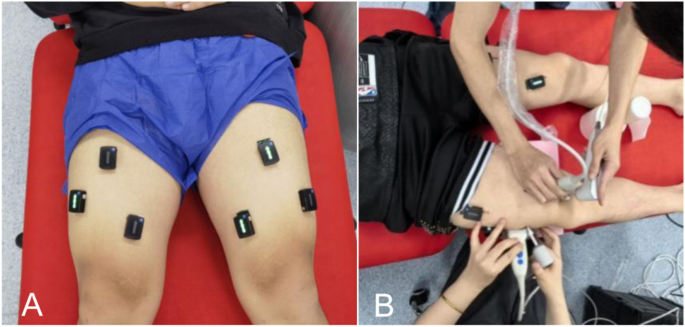
Research UseXijian Technology Portable Ultrasonic Mechanics Imaging EquipmentSystematically quantify the local mechanical characteristics of the quadriceps muscle in three states: resting, stretching, and contracting, and synchronously collect surface electromyography and functional scale data.
The research results indicate that:The key clue behind patellofemoral pain may not necessarily be the hardening or weakening of a muscle, but rather the disruption of the mechanical balance between the medial oblique muscle (VMO) and the lateral thigh muscle (VL) - and this imbalance is expected to be non invasively and objectively quantified.

BMC Musculoskeletal Disorders isSpringer NaturesubsidiaryBMCA series of open access, peer-reviewed journals focusing on the prevention, diagnosis, and management of musculoskeletal diseases, covering clinical orthopedics, biomechanics, rehabilitation equipment, exercise therapy, and medical imaging.
· 2024 Journal Impact Factor:2.4
· 2025 Downloads:10.1M
Why is patellofemoral pain difficult to assess?
The prevalence of patellofemoral pain (PFP) in the general population is approximately22.7%Among teenagers, up to28.9%It is a common problem in scenarios such as weight-bearing, running, jumping, and squatting.
Its complexity lies in the fact that patellofemoral joint load, lower limb force lines, hip and knee motion control, quadriceps state, and psychological factors may all be involved——Any single indicator is difficult to explain all the problems.
The more specific 'evaluation gap' lies in the fact that existing methods cover more areasOverall functionandBone/cartilage structureYes, that's rightMechanical balance within muscle groupsInsufficient attention.
-
The scale reflects symptoms and functions, but is subjectively influenced;
-
Physical examination is relatively simple and convenient, but difficult to quantify repeatedly;
-
MRI and traditional ultrasound are used to examine structures, but they are difficult to reflect muscle mechanics under static/dynamic conditions;
-
Surface electromyography reflects activation, but it is not equivalent to muscle stress.
What is truly lacking in PFP assessmentA tool that can objectively quantify local muscle mechanics in different functional states——Especially able to answer whether there is an imbalance within the muscle group and how severe the imbalance is.
How was the research completed?
Study Design & Measurement
Research included in total18 patients with unilateral patellofemoral pain(39.8 ± 11.9 years old) and20 healthy controls(30.3 ± 8.2 years old).
Focus on observing the three muscles in the quadriceps femoris——Medial oblique muscle (VMO), lateral thigh muscle (VL), rectus femoris muscle (RF)Measure in three different states:
·Resting position - Basic modulus in relaxed state
·Stretching position - knee flexion at 90 ° naturally droops, reflecting passive stress
·Contraction position - knee flexion at 15 °, single leg weight-bearing extension, reflecting active stress.
Synchronize the collection of two types of signals in each state:
supplemented AKPSand KOOS-PFScale to evaluate pain related functions. Through these data, the study attempts to answer a question that is closer to clinical practice:Can the mechanical imbalance of local muscles be linked to the symptoms and function of patients?
Discovery 1: It is difficult to see differences in the resting position, but they only become apparent in the functional state
At rest, there was no significant difference in VMO, VL, and RF between the two groups. The truly valuable signals are hidden in the stretching and contracting states:
-
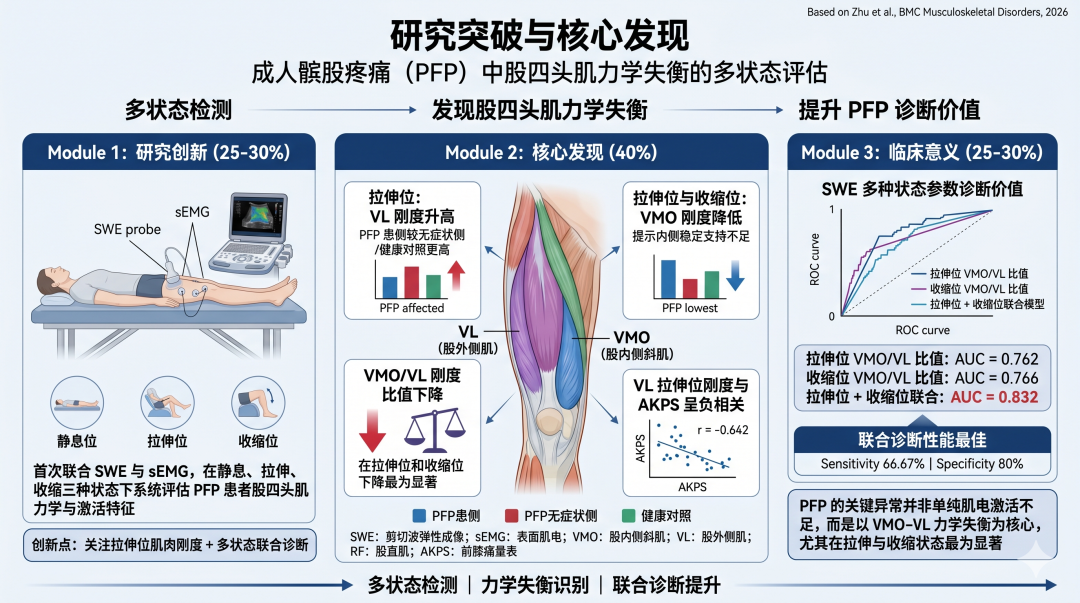
Stretching position, PFP affected side, VL equivalent modulus significantly increased (p=0.008 vs control; P=0.019 vs healthy side);
-
Stretching position, PFP affected side, VMO equivalent modulus significantly decreased (p=0.032 vs control);
-
Contraction position, PFP affected side, VMO equivalent modulus lower than healthy side (p=0.039).
Tip: Evaluating PFP should not only focus on the relaxed state - the true mechanical differences in muscles can only be seen when being pulled or used.
Discovery 2: PFP patients commonly experience a disruption in the mechanical balance between VMO and VL
The VMO/VL equivalent modulus ratio on the PFP affected side significantly decreased in all three states.
VMO and VL jointly affect the patellar trajectory and anterior knee mechanical environment. Once the mechanical ratio is imbalanced, the force distribution and motion control of the patellofemoral joint will be affected.
Compared to 'which muscle is stiff', 'relative balance between two muscles' is a more clinically significant indicator - this is also the core value that distinguishes local mechanics quantification from traditional subjective evaluation.
Discovery: Three | EMG cannot explain PFP alone
The ratio of VMO activation to VMO/VL activation on the affected side of PFP is higher than that on the healthy side, but the ratio in each group is still<1. This indicates that the muscle problems of PFP cannot be simply attributed to "insufficient activation of a certain muscle".
EMG reflects neuromuscular activation, while mechanics quantitatively reflects tissue mechanical properties - the two are complementary dimensions rather than substitutive relationships. The combined framework of "mechanics quantification+electromyography+scale" is closer to reality than any single indicator.
Discovering four joint multi state indicators significantly improves recognition ability
-
Tensile position VMO/VL equivalent modulus ratio: AUC=0.762
-
Shrinkage position VMO/VL equivalent modulus ratio: AUC=0.766
-
Combination of the two: AUC=0.832, specificity 80%, sensitivity 66.67%
In addition, the equivalent modulus of VL in the stretching position was significantly negatively correlated with AKPS score (r=-0.642, p=0.004) - that is to say, the higher the equivalent modulus of VL, the worse the patient's pain related functional performance.
This means that the local muscle mechanics parameters under multiple states are expected to become a new objective indicator for patellofemoral pain recognition and functional evaluation. It should be noted that this is an extension of the evaluation dimension, and there is still a certain distance to clinical diagnosis.
From 'Does it hurt' to 'Has mechanics improved?'
Significance & Translation
The potential application value of this study is worth noting, as it transforms the previous reliance on experience and scales for local muscle assessment into a set ofQuantifiable, interpretable, and traceableThe mechanical parameters are directly connected to the patient's real symptoms and functional experience.
thus,There is still room for further research in clinical follow-upHas the equivalent modulus of VL tensile position decreased? Has the VMO/VL ratio improved? Has the mechanical gap between the affected and healthy sides narrowed?
As research deepens, we believe that mechanical imaging will bring broader application space:
Clinical end——Rehabilitation and sports medicine departments, in addition to scales, physical examinations, and imaging, have an additional mechanical dimension that can objectively track the effectiveness of interventions.
Research end——Universities and sports colleges can reuse the paradigm of this study: "portable mechanics quantification+multi state tasks+synchronous electromyography+functional scale", which can be extended to areas such as muscle fatigue, postoperative rehabilitation, and return to exercise assessment.
training end——Sports teams and training institutions are expected to shift daily issues such as "recovery", "left-right symmetry", and "local abnormalities" from empirical judgments to objective data.
Starting from patellofemoral pain to broader soft tissue assessment - thusMake muscle state visible, measurable, and traceableThis is Xi Jian's long-term expectation for the path of musculoskeletal imaging technology.
1. Zhu G, Jia Y, Hao Y, Miao X, Zhang E. *Pain-related function, muscle stiffness, and muscle activation in adults with patellofemoral pain.*BMC Musculoskeletal Disorders.2026; 27:299. https://doi.org/10.1186/s12891-026-09710-3
2. Springer Nature Link – BMC Musculoskeletal Disorders aims and scope: https://link.springer.com/journal/12891/aims-and-scope
3. NLM Catalog – BMC Musculoskeletal Disorders: https://www.ncbi.nlm.nih.gov/nlmcatalog/100968565
Beijing Xijian Technology Co., Ltd. is based on more than ten years of research foundation in the field of human soft tissue mechanics characterization in the Laboratory of Biomaterials and Soft Materials Mechanics at Tsinghua University. It is committed to promoting the industrialization of human biomechanical imaging platform technology, focusing on clinical blue ocean demand markets such as sports health, dermatology, and major disease diagnosis and treatment.
Editor: Geng Tianshui | Producer: Zhang Liga
Design material source: Maker post, 96 editor