Academic News | Xijian Technology Equipment Helps Doctors Achieve High Precision Prediction of PFI!

Published on: 2025-05-30 14:53
 Read: 0


On May 30, 2025, Sun Yang's team from Peking University Third Hospital, together with the team from Beijing Chaoyang Hospital, published a groundbreaking study in the international journal BMC Musculoskeletal DisordersSuccessfully achieved high-precision prediction of PFI (especially patellar tilt and patellar high position), providing a new paradigm for non-invasive dynamic evaluation of PFI.
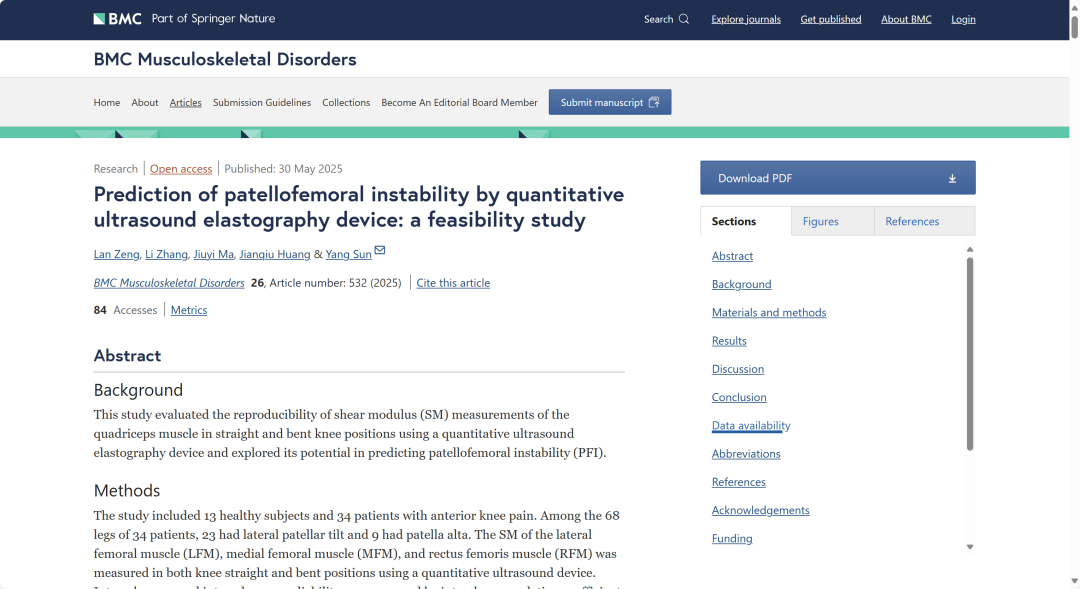
 

Article link:https://bmcmusculoskeletdisord.biomedcentral.com/articles/10.1186/s12891-025-08778-7


Clinical challenge: Lack of dynamic assessment methods for PFI

 
Knee pain troubles many people,The traditional diagnosis of PFI mainly relies on static imaging examinations such as X-rays, CT, MRI, etc. This often leads to a lack of objective mechanical indicators to guide the development of conservative treatment plans, such as rehabilitation training.
 
Anterior knee pain troubles approximately 25% of adults worldwide, with patellofemoral instability (PFI) being a significant contributing factor. When the patella loses its normal trajectory in the trochlear groove of the femur, it not only causes pain, but may also lead to cartilage wear and arthritis. Static imaging is difficult to capture the essence of dynamic imbalance.More importantly, there is a lack of dynamic and quantitative evaluation of the key stable structure - the mechanical state of the quadriceps muscle - in clinical practice, which often relies on subjective experience judgment by doctors for treatment plans.
 

New technologies, new equipment, new research

This study employed a novel quantitative technique in soft tissue mechanics,This technique is like conducting a 'hardness test' on muscles, reflecting tissue mechanical properties by measuring the shear modulus (SM).The detection equipment used is the soft tissue mechanics quantitative detector independently developed by the Xijian teamInnovatively adopting a separated design, this design overcomes the problem of signal attenuation and low signal-to-noise ratio in large muscle groups (such as quadriceps, thick fat layer, and high SM) using traditional methods.
research teamFirstly, the repeatability of the measurement results and the reliability of the detection equipment technology were verified.Healthy volunteer testing shows that musclesMeasurement values of shear modulus (SM) in straight and bent 90 ° positions: intra group consistency (repeated measurements by the same operator): ICC=0.964-0.993 (excellent); Inter group consistency (measured by different operators): ICC=0.770-0.966 (good to very good), indicating that the reliability of the technical methods and equipment used in this study has been rigorously validated.
 

Pioneering mechanical evaluation indicators, preciseLock in predicted targets

The study is the first to apply Shear Modulus (SM), a quantitative indicator of muscle hardness, to evaluate lateral patellar tilt and patellar elevation.We not only measured the SM values of different parts of the quadriceps femoris muscle (lateral femoris muscle LFM, medial femoris muscle MFM, rectus femoris muscle RFM) in a relaxed and extended state (static) of the knee joint, but also measured the SM values in a 90 ° bending (passive stretching state) of the knee joint, and calculated the "bend stretch difference", which reflects the passive stress of the muscle.
Researchers revealed the association between mechanical parameters and disease by comparing the SM differences between the disease group (PFI) and the non disease group. They conducted separate studies on "Lateral Patellar Tilt group vs control group" and "Patella Alta group vs control group"Comparative experiments,Dynamic measurements were performed on the lateral femoris muscle (LFM), medial femoris muscle (MFM), and rectus femoris muscle (RFM) of 68 limbs in 34 patients in two states of knee extension (0 °) and flexion (90 °).
Research has found that patients with patellar tilt have significantly higher values of lateral muscle SM (LFMbent), lateral/medial muscle SM ratio (L/Mbent), and lateral muscle bending extension difference (LFMbent strain) in the stretched (bent) state compared to those without tilt. Patients with high patellar position have significantly higher SM values (RFMdent) and RFMdent strain differences (RFMdent strain) of the rectus femoris muscle in a stretched state compared to those without high patellar position. The bending position and dynamic stress changes (flexion extension difference) can sensitively capture muscle mechanical imbalances, consistent with the pathological mechanism of PFI (lateral tension ↑, patellar tendon tension ↑).

Efficient prediction of disease occurrence using mechanical parameters

The researchers conducted high-quality predictive performance (ROC/AUC validation) on the study, and predicted patellar tilt: LFM foot track performed the best, with an AUC of up to 0.907 (95% CI: 0.832-0.982). When the critical value is set to 49.14 kPa, the sensitivity is 78.26% and the specificity is 93.33%.This means that the indicator can accurately identify patients with real problems, with a low misjudgment rate.Predicting patellar elevation: The AUC of RFMdent and RFMdent stage were 0.727 and 0.729, respectively,It also demonstrates good predictive value.
The research results support the theory of mechanical imbalance in the quadriceps muscle in PFI. Lateral patellar tilt may be related to abnormally increased stress on the lateral thigh muscle, while patellar elevation is related to abnormally increased stress on the rectus femoris muscle.This provides new insights into understanding disease mechanisms and guiding targeted therapies, such as selective muscle relaxation or strengthening training.

New technological equipment assists in precise diagnosis and rehabilitation evaluation

The study conducted by Peking University Third Hospital and Beijing Chaoyang Hospital successfully broke through the limitations of traditional static evaluation of PFI and achieved high-precision prediction based on quadriceps muscle mechanics parameters for the first time.Xijian Technology equipment is the core technical support for this research,Its rigorously validated equipment reliability and excellent predictive performance (AUC>0.9)This has laid a solid scientific research foundation for the non-invasive and quantitative evaluation of patellofemoral joint instability and even musculoskeletal system mechanics.This technology is expected to become another powerful weapon for clinical doctors to evaluate knee joint stability, bringing more accurate diagnosis and rehabilitation plans to patients.

Product Showcase


图片

Quantitative testing instrument for soft tissue mechanics

<<<Swipe left to see more

图片

Quantitative testing instrument for soft tissue mechanics

>>>

Xijian Technology is the world's first soft tissue mechanics quantitative testing device, which is based on non-invasive mechanical quantitative testing scenarios of soft tissue in vivo. It performs mechanical quantitative testing on muscles and tendons in multiple dimensions such as structure, performance, and function. Widely used in the quantitative mechanical evaluation of muscles in various parts of the human body, such as quantitative evaluation of muscle strength and tension, diagnosis of shoulder and neck pain and tenosynovitis, assessment of muscle fatigue, assessment and screening of muscle atrophy, etc.

About Xijian


Beijing Xijian Technology Co., Ltd. is based on more than ten years of research foundation in the field of human soft tissue mechanics characterization in the Laboratory of Biomaterials and Soft Materials Mechanics at Tsinghua University. It is committed to promoting the industrialization of human biomechanical imaging platform technology, focusing on clinical blue ocean demand markets such as sports health, dermatology, and major disease diagnosis and treatment.
 
Editor: Geng Tianshui | Producer: Zhang Liga
Design material source: Maker post, 96 editor


Share
  • toolbar
    Contact
  • toolbar
    Top